Vernacular architecture and design hold a special place in our hearts. It is so deeply rooted in our experiences and encounters that we always look forward to digging into those memories and shaping a home accordingly. Needless to say, we were thrilled when we had the opportunity to do so with the Katariya House. The client’s brief was simple: a traditional, minimalistic interior that would not only fulfil their functional needs but also address privacy and social requirements.
Through continuous interaction with the client and understanding their interests, values, opinions, altitude, and lifestyle, we developed a Transitional Style. With the final design, our aim is to showcase the bond between their traditional roots and their modern minimalist lifestyle, achieving a sense of balance that is both appealing and unexpected.
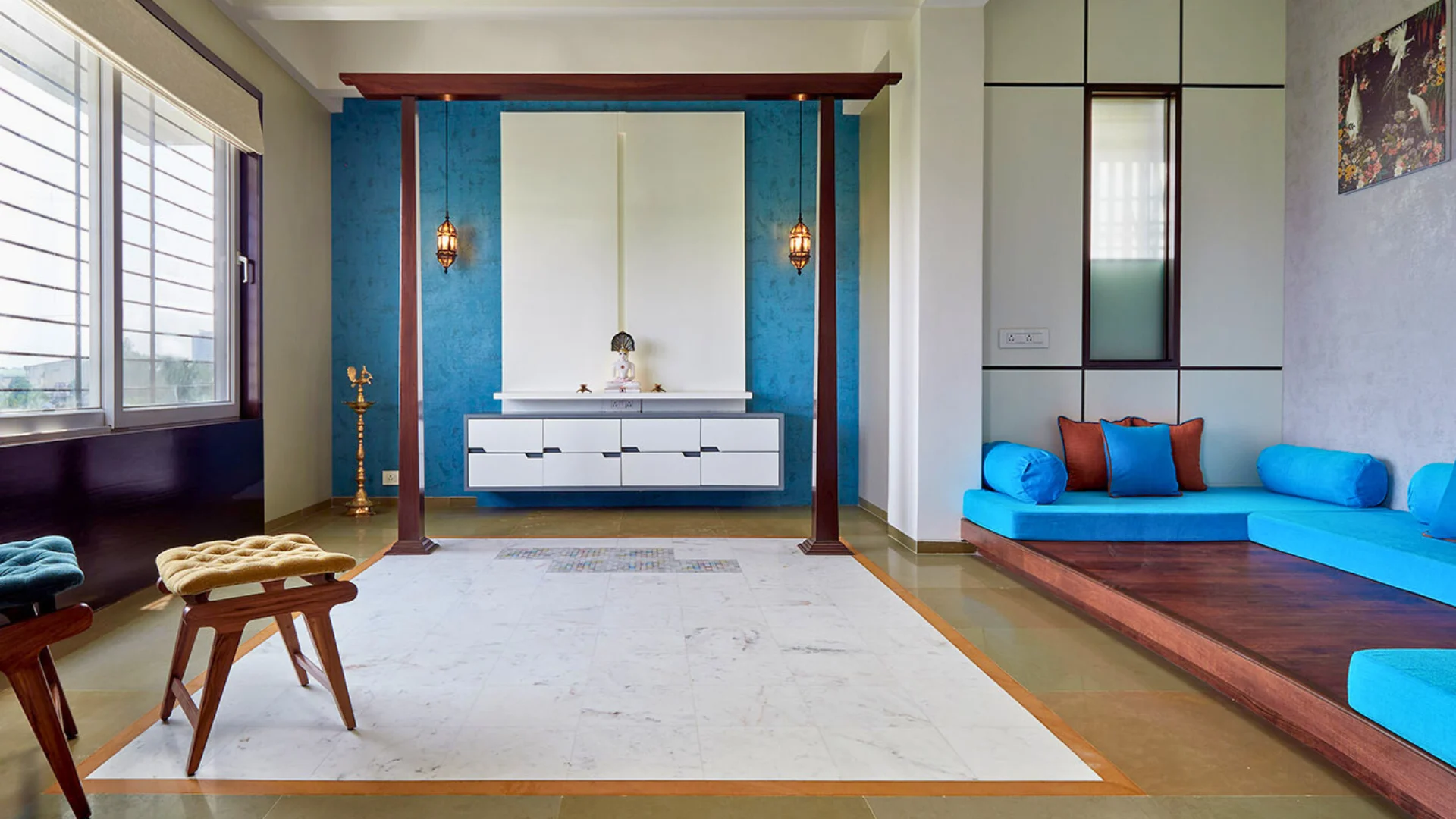
In the living room, we’ve avoided a false ceiling to maintain clear height and a sense of grandeur. Further, simple track lighting in passages and cylindrical surface lighting is utilised to enhance different volumes. The use of natural yellow tandoor stone for flooring imbues it with a perfect vernacular Indian wada touch. Additionally, the diwan, custom-made sofas, brass accents, and chequered Shahabad pattern in flooring (designed to create a carpet or chattai effect) add a traditional touch.
A fusion style incorporating different textures such as wooden furniture, brass accents, authentic Indian artwork, and bright upholstery flows throughout the home. The living room further leads to the mandir area with marble inlay flooring. Adjacent to it is the informal living room with low-height seating options for relaxed interactions.
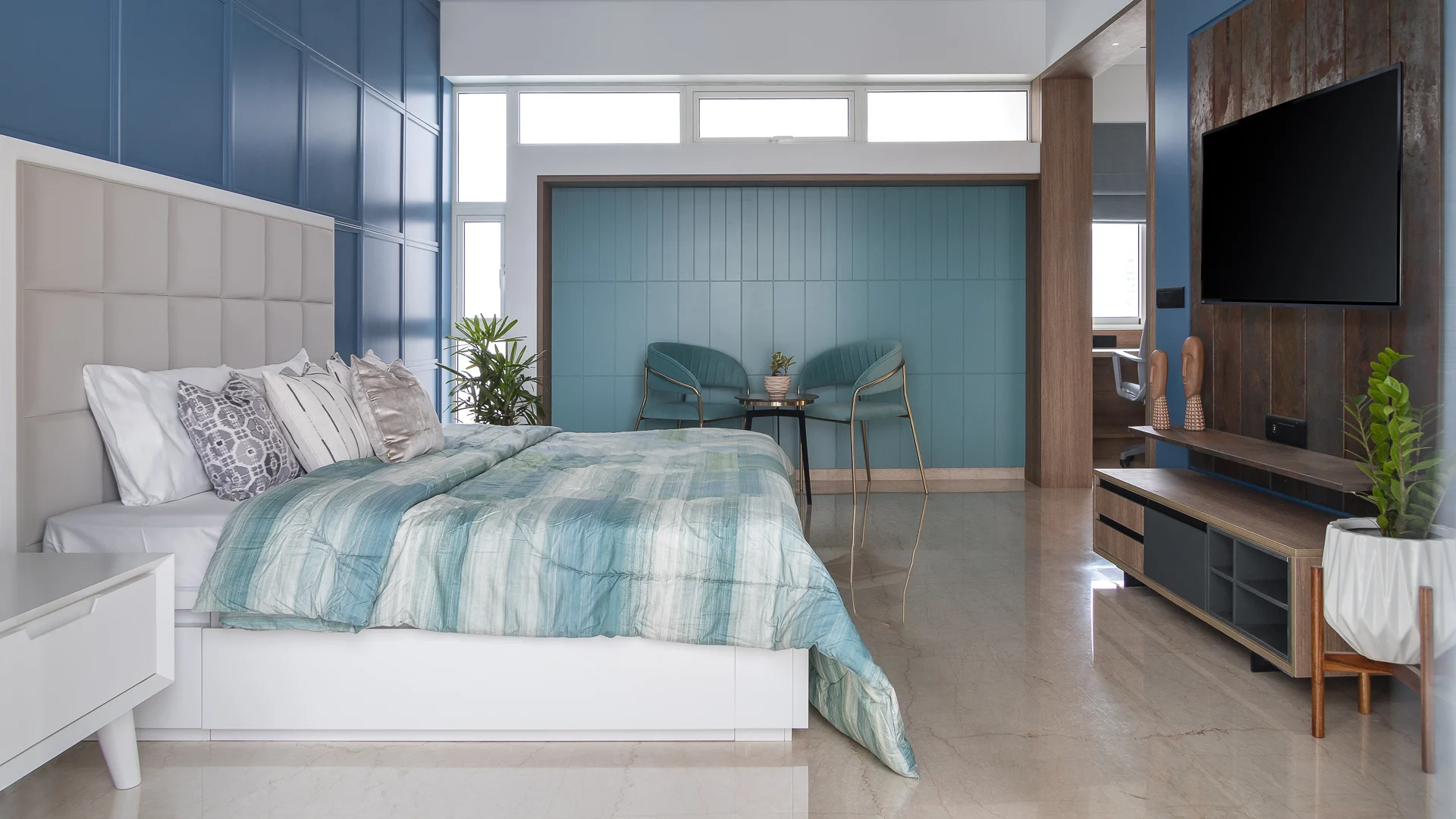
On the opposite side, a passage leads to the bedrooms. At the client’s request, the main bedroom features yellow Jaisalmer stone flooring with a vintage-themed white four-poster bed and a minty turquoise hue background panel to perfectly balance the focal elements of the room. In the daughter’s bedroom, wood, exposed brick, and vibrant upholstery come together to create a modern, eclectic vibe, while in the sons’ bedroom, the ambiance is more moody with dark fabrics, indirect lighting, and varying shades of grey aesthetic.
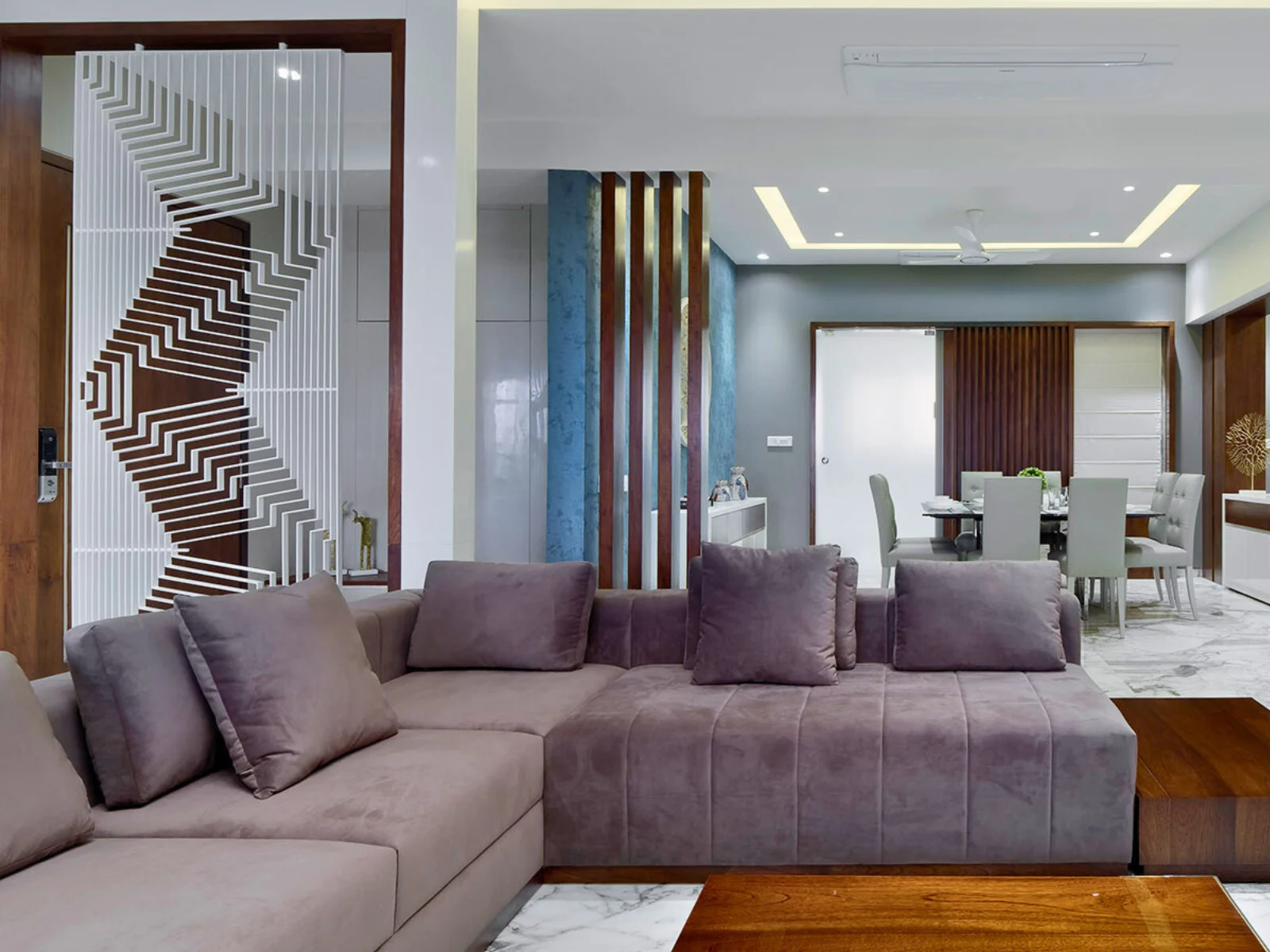
When working on interiors, it’s rare to find spacious and free-flowing communal areas that seamlessly bind the home together. However, we were thrilled to discover that the layout of the Mavdikar House already included an enormous living area with smooth connectivity to the kitchen and dining. We decided to further enhance this living room, transforming it into a space perfect for both large gatherings and intimate conversations, with additional corners carved out for relaxation and unwinding. Moreover, the room enjoys a phenomenal view, so we oriented the furniture to face it, making it the focal point of the space.
The overarching theme of the home revolves around simple detailing devoid of decoration, strategic use of materials for visual interest, texture, and personality, featuring uncomplicated claddings and wall finishes, and clean, open spaces flooded with ambient light.
Adjacent to the living room is the dining area, adorned with custom-made furniture and curated antique pieces for a traditional touch. Between the dining area and the reading corner, a tailored bookshelf-cum-partition unit offers privacy while maintaining visual connectivity.
While the communal area boasts traditional furniture accents, the bedrooms draw inspiration from a European aesthetic, featuring painted accent walls and soft, neutral furnishings. The main bedroom adopts a turquoise blue and white colour scheme with ample greenery adding a refreshing hue to the design. To fully appreciate the view and natural light, the bedrooms purposefully avoid partitions, employing halftone, neutral colour schemes and minimalistic furniture to create a spacious layout conducive to relaxation.
In our relentless pursuit of merging vernacular design with modern lifestyles, one project remains etched in our memory as an all-time favourite: the Mudra House. An innovative endeavour, it marks one of our first experiments with introducing a water element into communal areas and diving deep into thoughtful, tailored furniture inclusions throughout the home.
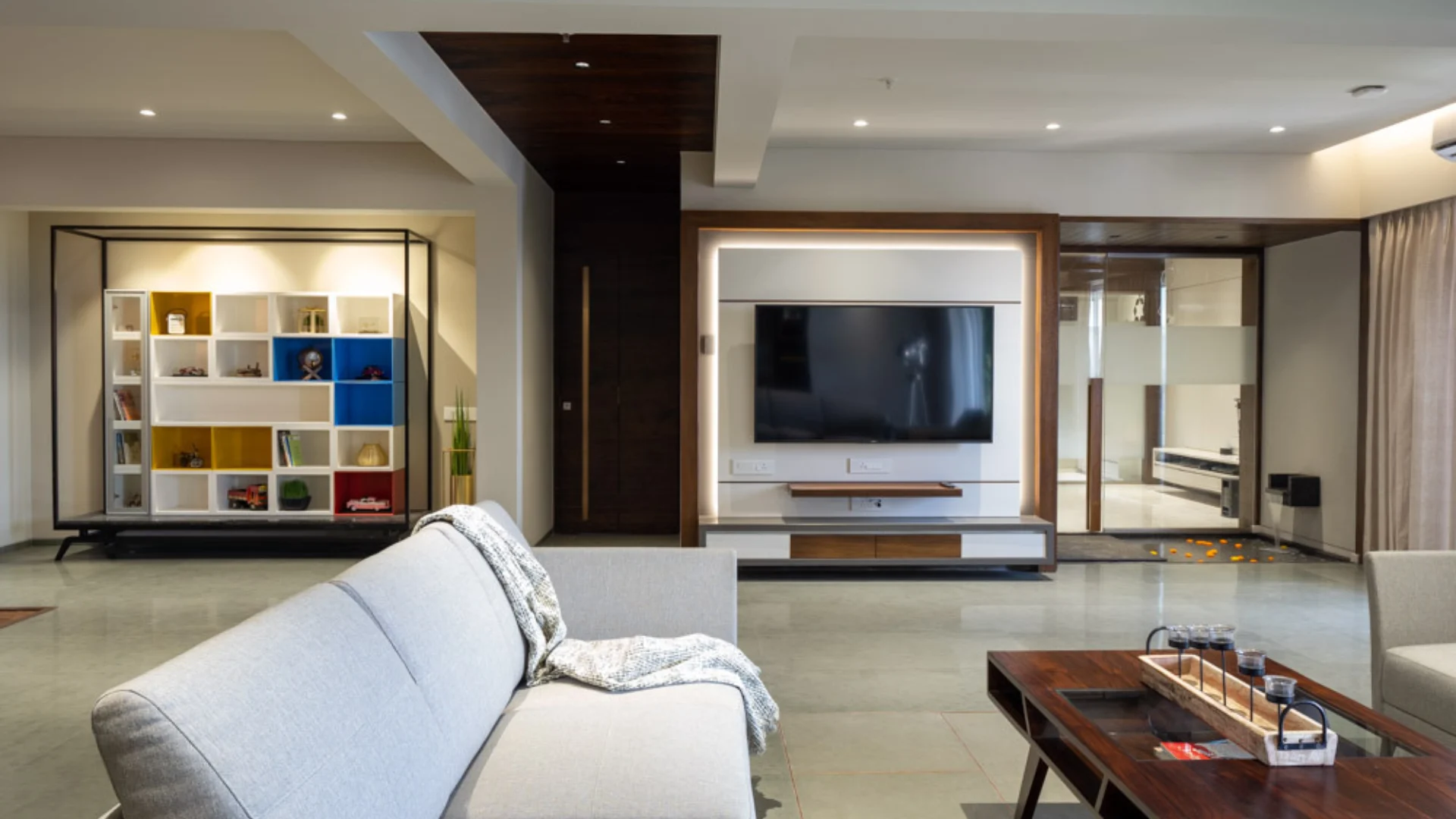
When the client initially approached us, the goal was to merge two adjacent residential units to create a spacious home entirely based on Vastu principles. The client’s preference for Indian architectural aesthetics further motivated us to incorporate vernacular elements into every space while avoiding unnecessary panelling and decoration. To highlight the original architectural structure of the space, a neutral colour palette flows throughout the home, with dominant wood furniture complemented by metal accents and vibrant colours in furnishings.
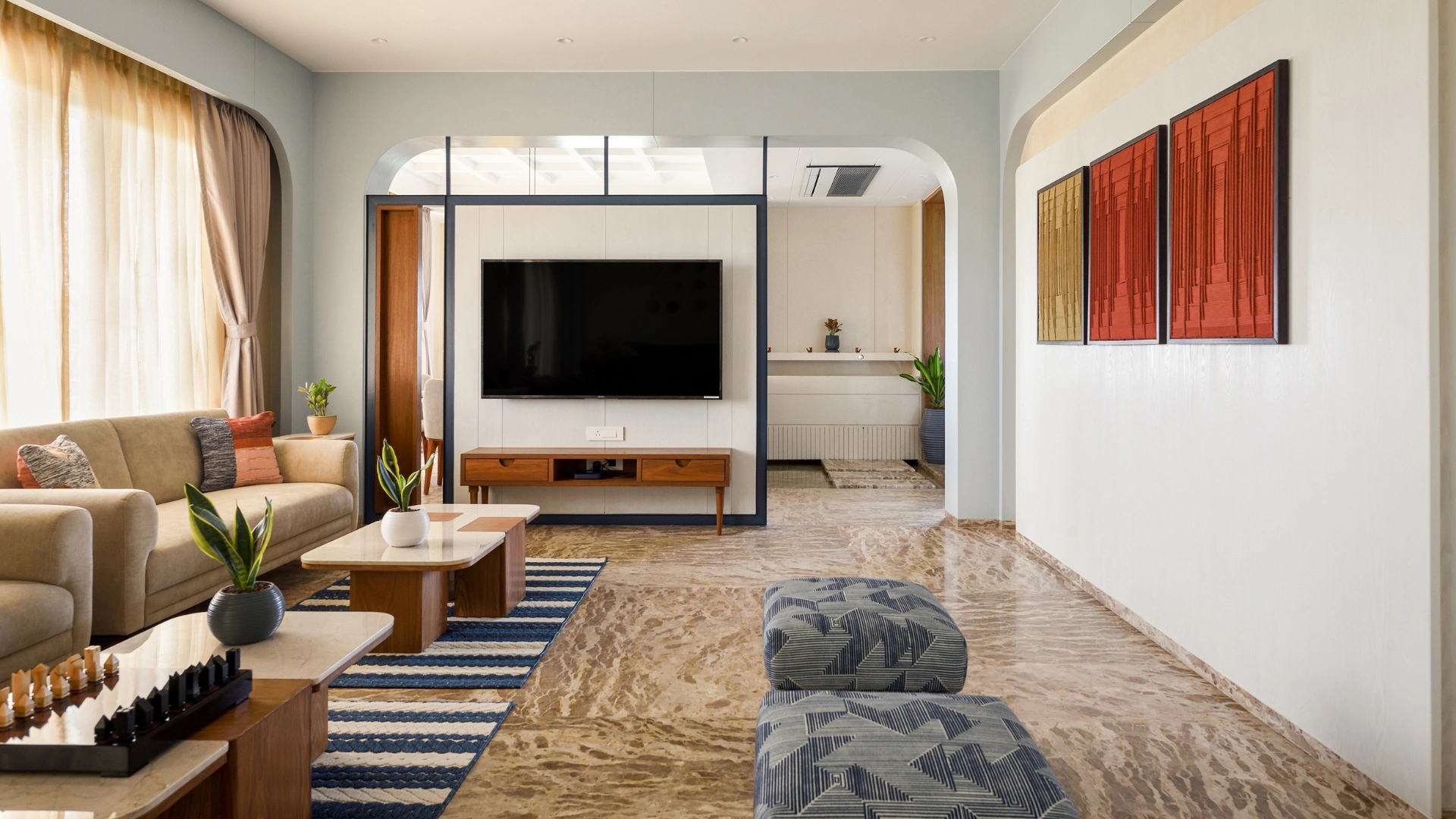
Both the formal and informal living rooms feature subtle wooden detailing, with the tailored showcase unit stealing the focus. On the opposite side of the living room lies the water element, discreetly leading to another informal living area and the mandir. The water element is envisioned as a sensory experience, allowing one to step into the water before entering the mandir.
Ergonomics and climate-responsive elements take centre stage in the bedroom design, influencing every choice, from the louvred windows to the green wall and the low-height furniture with additional and flexible supports, among other elements.
Ever so often, you encounter someone with whom you sense an inevitable collaboration in the future—it’s just a matter of when and how. Our initial interactions with the Rathod family had that very vibe, and by 2022, the path forward became clear. We were tasked with rebuilding their family home, the Shantai bungalow.
Revamping the bungalow was no small feat, especially given the client’s unwavering commitment to preserving the original structure, crafted by his father. Once our structural consultants gave the green light after assessing the building, the real challenge emerged. This three-storey bungalow, with one side abutting a commercial office facing the road, presented a formidable obstacle. In a rare twist, our focus shifted from design to load calculations.
Though the process was new and demanding, the outcomes were equally rewarding. A modern facade took shape through meticulous fabrication, with additional columns carefully shouldering the weight of this new frontage.
As for the interiors, the client was resolute from the outset. Having spent a lifetime in a traditional home, the three-generation family now yearned for a contemporary space that mirrored their modern lifestyle. What’s more, the client had a discerning eye for every detail of his dream home, from sofa cushions to cutlery. Given the family’s stringent specifications and the challenge of accurately distributing load calculations, designing the home in a detailed 3D emerged as the best possible solution. Once every aspect was meticulously approved, construction commenced on site.
Today, with columns and foundations laid by the client’s father standing firm and intact, the bungalow boasts a contemporary charm, offering a modern sanctuary perfectly attuned to today’s lifestyle.
House of Grids is a contemporary four-bedroom apartment in Pune, designed as an intriguing overlap of geometric patterns, textures, and shapes. Built on the foundation of Vastu principles, the home showcases a mesh of concealed detailing, wood and mild steel furniture, and vintage elements. It revels in a series of thoughtful wall compositions and colour drama, employing repeating patterns to either hide or highlight storage units.
Designed with a frequent guest flow in mind, the living room offers multiple seating options, with the mandir area hidden behind a veil of sliding glass. The choice of sliding glass doors is deliberate, aiming to foster a visual dialogue while enhancing physical intimacy during gatherings.
As for the dining area, the family had a small request: to incorporate a designer chandelier over the dining table. This led to the displacement of the standard ceiling fan, replaced by a table-side antique one, subtly nodding to the fusion theme of the home. The modular kitchen replicates the home’s grid aesthetic in its overhead storage cabinets, adding a refreshing splash of blue.
The Parents’ Bedroom is a tranquil space adorned in soothing blues, featuring a striking MS square grid as the bed back wall design, complemented by another ocean-grid backdrop for the cosy coffee furniture. The TV unit, tailored in-house, is crafted from corten steel, rusted for effect and coated with platina.
Conversely, the eclectic Kids’ Bedroom showcases playful panels and a chevron-patterned micro concrete floor. Handles and hardware are minimised to incorporate flushed grooves in furniture, providing ample storage for a sturdy study desk and visualising the room as a stimulating force of creativity, with dynamic shades and shapes.
A single piece of fabric stretches seamlessly from the bed-back panel and the floor-length curtains to the glass wardrobe shutters in the pastel-themed Guest Bedroom. For big games and movie nights, a small media room welcomes the congregation of friends and family, featuring vertical lighting and contrasting teal upholstery to add a modernist character.
Conceptualised by Studio Arcon, a Pune-based architectural practice, the home draws inspiration from the rich Wada architecture synonymous with the city. Founders and Principal Architects, Jinesh Dhumavat and Shekhar Nahar, transform this space into simplistic compositions with vintage-style detailing and comforting combinations of wood and rattan furniture.
In the quest for our dream homes, we often find ourselves drawn to the past—a delightful paradox where comfort resides in the creases of memories, gently tugging at our heartstrings. One such nostalgic trip, of a family of four, led to the creation of Visava, a vibrant three-bedroom apartment in Pune.
Whispers of Wada
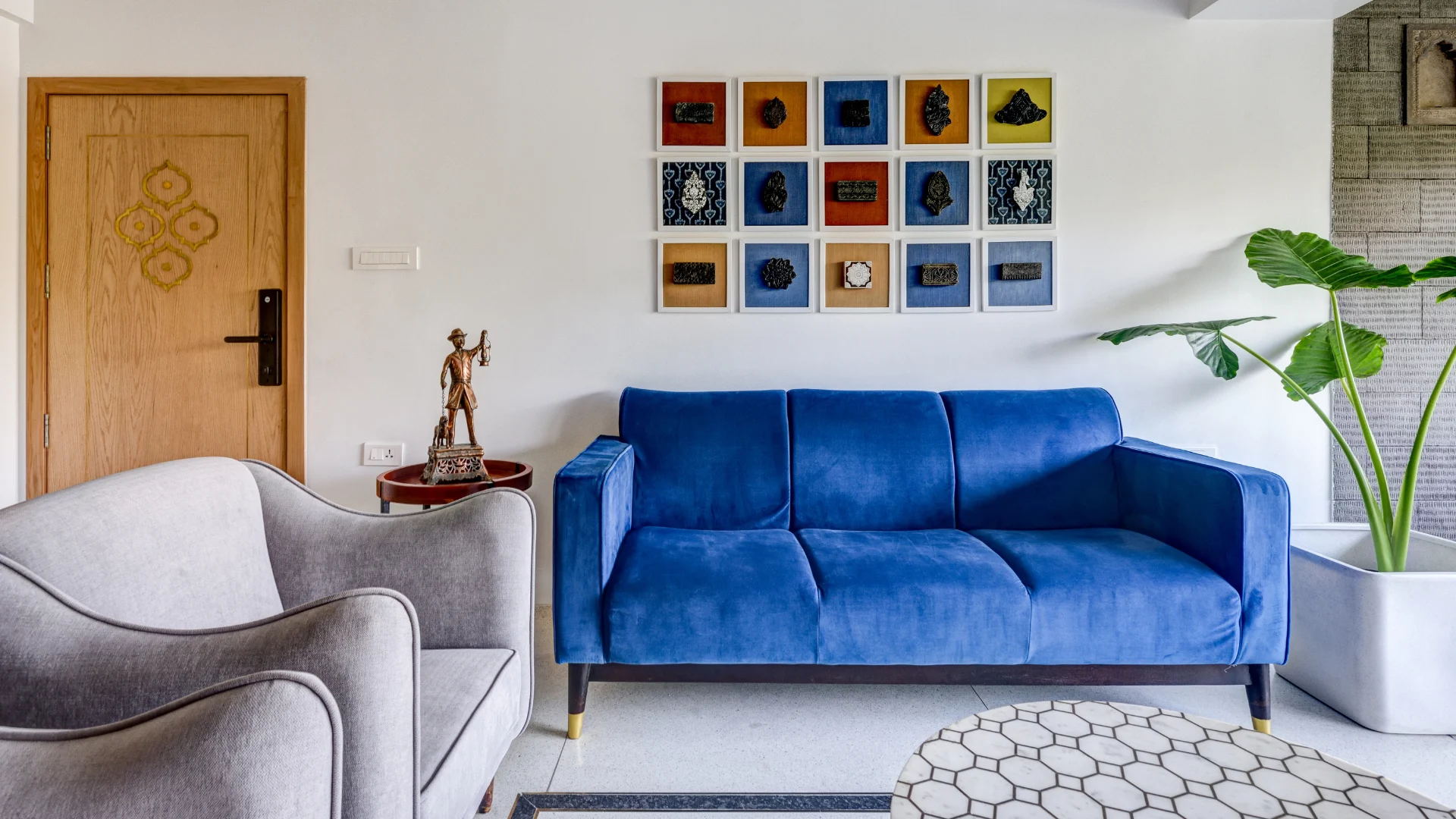
In Marathi, Visava denotes a feeling of comfort and rest. An ode to the family’s Maharashtrian heritage, the 1500 sq ft apartment is a modern-meets-traditional tale. With minimalist and Maharashtrian on the mood board, the living room features multi-coloured stamps in perfectly framed rows. The kaleidoscopic backdrop inspires rich shades of blue and rusty red in the surrounding customised furniture. On careful observation, one would discover the famous Kathpadar saree reimagined as an art piece above another charmingly artsy console.
While a courtyard is but a dream in an apartment, the Wada theme of the home mandates natural light and ventilation. On cue, the studio demolishes the wall between the living and the balcony to extend the communal areas into the refreshing greens of Bhosale Nagar. The extended living is now a dedicated unwinding spot with a stunning sunset view.
A juxtaposition of the black basalt against the gentle glow of the devalis further enunciates the aesthetic appeal of this space. Fashioned from wood and nostalgia, the timeless hindola (wooden swing) rekindles cosy memories reminiscent of lazy summer afternoons. The living room flooring differentiates itself with a terrazzo carpet effect, matched with contrasting tiles in the extended living area. This play of tactile surfaces is a prominent feature of Studio Arcon.
Down to the bare minimum
Diagonally placed, the dining savours darker tones of blue. It serves as the soul of the home, leading to the kitchen and the main bedroom on the left and the children’s bedroom on the right. A daring venture, the modular kitchen unveils a rare colour combination of deep, alluring black with invigorating blues. Without the right amount of light, blue can feel gloomy and overbearing. Fortunately, the studio factors in the maths and introduces a full-height window on the other side.
The absence of handles creates a smooth, streamlined look, with J-pull drawers adding extra poise. The running black backsplash tiles with white grout lines provide a sense of visual tactility to the space, while the LED strip lighting is purposefully placed to avoid casting any unwanted shadows.
Stepping out, one would find the entrance to the main bedroom. Envisioned as an inviting sanctuary, the room revels in its architectural character. A simple wooden bed serves as a centrepiece, complemented by a traditional trunk-style bedroom bench and a meticulously designed wood and rattan wardrobe.
Enunciating its bare minimum philosophy, the wardrobe is remodelled as a wall in itself, with smooth grooves and a tucked-in dresser niche. But, it is the CNC cut bed back that truly steals the show, with its exceptional craftsmanship and attention to detail. Adorned with typical traditional forms and shapes, it gracefully underlines Visava’s Wada-inspired design concept.
Adapting to the enthusiasm
Additionally, as the owner is a cycling enthusiast, a bespoke wall stand is installed on the terrace to host the bike as an accent piece. The vibrant cement tile flooring here adds yet another layer to the theme.
On the other end of the home, the compact daughter’s bedroom presents a circulation challenge. While meticulously rearranging furniture, an ingenious idea springs forth: a low platform bed with a custom-built niche to snugly hold the mattress. Solving the circulation conundrum, the bed is anchored against the window wall.
To complement this innovative design and the daughter’s personality, a micro concrete, wood and mild steel fusion wardrobe is added to display her treasured art and accessories. Since the son is settled abroad, his bedroom doubles up as a workstation with a collapsible bed and a spacious wardrobe.
To best adapt to both the opposing worlds, Visava pairs the colours and materials of a traditional architectural style with the evolving aesthetic of a modern lifestyle.